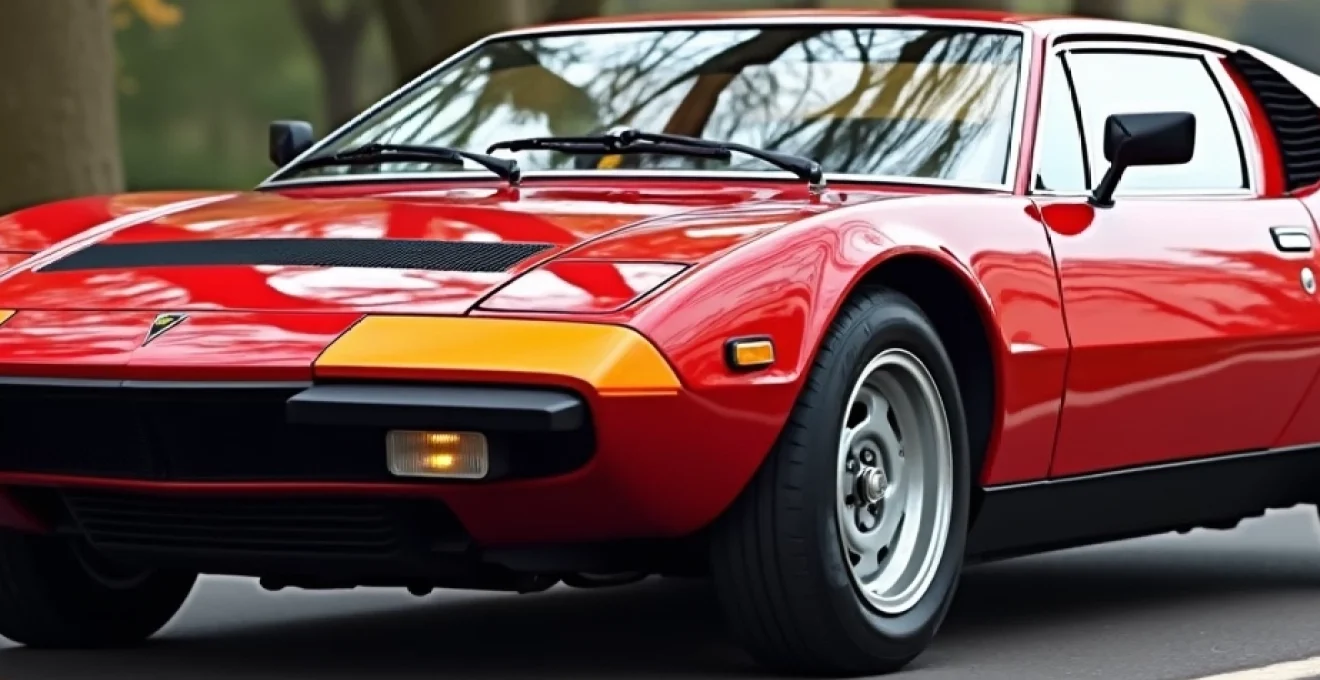
The De Tomaso Pantera stands as one of the most compelling Italian-American hybrid supercars ever produced, combining the passionate styling of Italian coachwork with the reliable power of American V8 engineering. This mid-engine marvel, born from Alejandro de Tomaso’s vision and Tom Tjaarda’s design genius at Ghia, represents a unique proposition in the classic car market—offering supercar performance with relatively accessible maintenance costs. From 1971 to 1993, only 7,260 examples rolled out of the Modena factory, making each surviving example increasingly precious to collectors and enthusiasts alike.
The Pantera’s distinctive wedge silhouette and Ford Cleveland V8 soundtrack continue to captivate automotive enthusiasts decades after production ceased. Unlike its temperamental Italian contemporaries, the Pantera offers the rare combination of exotic aesthetics with proven mechanical reliability, thanks to its Ford powerplant and ZF transaxle foundation. Today’s market presents both opportunities and challenges for prospective buyers, as values continue their upward trajectory while finding genuinely unmolested examples becomes increasingly difficult.
De tomaso pantera production evolution and model variants
Understanding the Pantera’s evolution across its 22-year production run proves essential for making informed purchasing decisions. Each phase brought significant mechanical and aesthetic changes that directly impact both driving experience and collector value. The model’s development reflects the tumultuous relationship between De Tomaso and Ford, regulatory pressures, and evolving market demands throughout the 1970s and beyond.
1971-1974 Pre-L model specifications and ford cleveland 351 integration
The earliest Panteras represent the purest expression of the original concept, featuring hand-formed Vignale bodywork and the most potent engine configurations. These foundation models came equipped with the Ford 351 Cleveland V8 producing 330 horsepower in European specification, delivered through the renowned ZF S5-42 five-speed transaxle. The initial 75 cars imported to the United States maintained this high-compression setup before emissions regulations necessitated modifications.
Pre-L models exhibit several distinctive characteristics that separate them from later variants. The European-style door releases, chrome bumpers, and specific interior trim pieces mark these early cars as particularly desirable among purists. However, quality control issues plagued early production, with extensive use of body filler and inconsistent paint application becoming common concerns. The initial cars also featured the controversial slatted seats from the show car, quickly replaced by more conventional seating in production vehicles.
1974-1982 pantera L performance upgrades and bumper modifications
The Pantera L, introduced in August 1972, addressed many early production shortcomings while adapting to American market requirements. The distinctive black rubber bumpers front and rear not only satisfied low-speed impact regulations but also provided aerodynamic benefits at higher speeds. Interior improvements included repositioned instruments for better visibility, upgraded seating, and enhanced climate control systems that actually functioned reliably.
Engine specifications varied significantly during this period, particularly between American and European markets. US models received detuned 296-horsepower engines to meet emissions standards, while European variants maintained higher compression ratios and power outputs. The L model’s maturation process culminated in Road Test Magazine’s Car of the Year award in 1973, validating the improvements made over early production vehicles. These refinements make L-model Panteras excellent entry points for first-time buyers seeking proven reliability.
1980-1985 pantera GT5 Wide-Body aerodynamic package assessment
The GT5 represents the Pantera’s transformation into a more aggressive, track-focused machine. Introduced in 1980, this variant featured dramatic fibreglass wheel arch extensions that accommodated massive 13-inch rear wheels wrapped in 345/35-15 tyres. The revised front air dam significantly improved high-speed stability while the overall aerodynamic package enhanced both cooling and downforce generation.
Power increased to 350 horsepower despite a reduced 9.5:1 compression ratio, achieved through improved breathing and revised cam timing. The GT5’s visual impact cannot be overstated—the wide-body stance and aggressive aerodynamics created an unmistakably purposeful appearance that influenced supercar design throughout the 1980s. However, the riveted-on body extensions can complicate restoration efforts and may hide structural issues in compromised examples.
1985-1993 GT5-S final production run and collector market impact
The GT5-S replaced the fibreglass extensions with integrated steel bodywork, creating the most cohesive and refined Pantera variant. Limited to approximately 183 examples, these final iterations featured luxurious interiors, improved build quality, and the most sophisticated aerodynamic package of any production Pantera. The seamless integration of the wide-body elements eliminated the reliability concerns associated with the GT5’s add-on components.
Today’s collector market places particular emphasis on GT5-S examples due to their rarity and advanced engineering. The steel construction provides superior long-term durability compared to fibreglass alternatives, while the refined interior appointments appeal to buyers seeking grand touring comfort. However, finding unmolested examples proves challenging, as many have been modified with aftermarket components or subjected to questionable restoration attempts.
Ford 351 cleveland V8 engine technical analysis
The heart of every Pantera beats with distinctly American rhythm, courtesy of Ford’s legendary 351 Cleveland V8. This engine family’s selection for the Pantera programme reflected both practical considerations and performance requirements. The Cleveland’s robust construction, extensive aftermarket support, and proven reliability made it ideal for European assembly while maintaining service accessibility through Ford’s global network. Understanding the various Cleveland configurations helps buyers identify authentic specifications and assess modification potential.
Closed chamber vs open chamber head configuration differences
Cleveland engines utilised two primary combustion chamber designs that significantly impact performance characteristics and authenticity. Closed chamber heads, featuring smaller combustion chambers and higher compression ratios, equipped most European Panteras through the mid-1970s. These heads produce superior power output but require higher octane fuel and careful tuning to prevent detonation. The closed chamber design’s superior flame propagation and reduced surface area contribute to more complete combustion and higher thermal efficiency.
Open chamber heads, introduced primarily for emissions compliance, feature larger combustion chambers and reduced compression ratios. While producing less peak power, these heads offer greater detonation resistance and broader fuel compatibility. Identifying head types requires careful inspection of combustion chamber shape and volume, as external appearances remain virtually identical. Original specifications matter significantly for both authenticity and performance expectations.
Compression ratio variations across production years
Compression ratios varied dramatically across Pantera production, reflecting changing emissions standards and fuel quality concerns. Early European models featured 11:1 compression ratios that maximised power output but demanded premium fuel availability. American market cars received progressively lower compression ratios, dropping to 8.6:1 by 1974 to accommodate unleaded petrol requirements and catalytic converter compatibility.
These variations create significant performance differences between seemingly identical engines. High-compression examples deliver the visceral acceleration that defines the Pantera experience, while lower-compression variants offer more docile characteristics suitable for regular driving. Modern fuel quality improvements allow many owners to safely increase compression ratios during rebuilds, though careful consideration of intended usage remains essential for optimal results.
Weber 4150 carburettor setup and tuning considerations
Most Panteras left the factory equipped with Weber 4150 four-barrel carburettors, though some variations exist depending on market requirements and production periods. The Weber setup provides excellent throttle response and power delivery when properly tuned, but requires more maintenance attention than modern fuel injection systems. Carburettor tuning significantly impacts both performance and drivability, with factors including altitude, climate, and fuel quality all influencing optimal settings.
Common Weber issues include accelerator pump diaphragm failures, float bowl problems, and progressive linkage wear. Regular cleaning and adjustment schedules help maintain optimal performance, while upgrade paths include electronic ignition systems and improved fuel delivery components. Many owners have successfully converted to electronic fuel injection, though such modifications may impact authenticity and market value for concours-quality examples.
Common engine bay heat management issues and solutions
The Pantera’s mid-engine configuration creates significant heat management challenges that affect both performance and component longevity. The enclosed engine bay can reach extreme temperatures during extended driving, particularly in warm climates or stop-and-go traffic conditions. Original cooling system designs proved marginal at best, leading to frequent overheating incidents that could cause severe engine damage if not addressed promptly.
Effective solutions include upgraded radiator cores, improved cooling fan systems, and enhanced heat shielding around sensitive components. Many successful modifications involve relocating heat-sensitive elements such as fuel pumps and ignition components to cooler locations within the engine bay. Proper heat management not only prevents mechanical failures but also maintains consistent performance throughout extended driving sessions.
The Cleveland V8’s robust construction tolerates heat cycling better than many contemporary engines, but preventive measures remain essential for long-term reliability and performance retention.
ZF S5-42 transaxle system evaluation
The ZF S5-42 five-speed transaxle represents one of the Pantera’s most sophisticated mechanical components, shared with exotic contemporaries including the Maserati Bora and Ford GT40. This German-engineered gearbox provides the essential link between American power and Italian chassis dynamics, but its complexity and expense demand careful evaluation during pre-purchase inspections. Understanding ZF transaxle characteristics, common failure modes, and maintenance requirements proves crucial for informed buying decisions.
ZF transaxles deliver precise, mechanical shifting feel that enhances the Pantera’s sporting character. The distinctive gated shifter provides positive engagement and prevents accidental gear selection, though proper technique requires learning for drivers accustomed to conventional transmissions. Gear ratios suit both high-speed touring and spirited driving, with well-spaced increments that maximise engine performance across the rev range. However, early production units exhibited excessive noise levels that were gradually reduced through improved manufacturing tolerances and revised internal components.
Maintenance requirements exceed those of conventional gearboxes, with specific lubricant requirements and more frequent service intervals. Synthetic gear oils provide superior protection and shifting quality compared to period-correct alternatives, though some concours judges may require original specifications. Rebuild costs can reach £8,000-12,000 or more, making transaxle condition assessment absolutely critical during purchase negotiations. Signs of impending failure include difficult shifting, gear selection problems, and excessive noise during operation.
Clutch systems interface directly with the transaxle and require similar attention to detail. The hydraulic clutch actuation system provides excellent modulation but proves sensitive to contamination and component wear. Regular fluid changes and system bleeding prevent most problems, though master and slave cylinder replacements represent common maintenance items. Clutch disc life varies significantly based on driving style and adjustment quality, with properly maintained systems providing 40,000+ miles of service life.
Chassis construction and suspension geometry analysis
The Pantera’s unibody construction represents a departure from De Tomaso’s earlier backbone chassis designs, prioritising structural rigidity and production efficiency over ultimate weight savings. This steel monocoque provides excellent crash protection and handling precision while simplifying manufacturing processes for higher production volumes. However, the all-steel construction creates vulnerability to corrosion that demands careful inspection and preventive maintenance throughout ownership.
Suspension geometry delivers exceptional handling balance for a mid-engine configuration, avoiding the tail-heavy characteristics that plague some contemporary designs. Independent suspension front and rear utilises double wishbone layouts with coil springs and telescopic dampers, providing both comfort and control across varied driving conditions. The sophisticated geometry allows precise wheel control throughout suspension travel while maintaining reasonable ride quality for grand touring applications.
Weight distribution approaches the ideal 40/60 front-to-rear split, contributing significantly to the Pantera’s balanced handling characteristics. This distribution, combined with the low centre of gravity inherent in mid-engine designs, creates exceptional cornering capabilities that rival modern supercars. However, the rear weight bias demands respect during limit handling, as recovery from oversteer situations requires skilled technique and quick responses.
Brake systems evolved throughout production, with later models receiving improved ventilated disc designs and upgraded caliper specifications. Early cars featured solid discs that proved marginal for sustained high-speed driving, while later variants incorporated proper cooling vanes and larger rotor diameters. Modern brake pad compounds significantly improve stopping power compared to original specifications, though some formulations may prove too aggressive for street driving applications.
The Pantera’s chassis engineering demonstrates remarkable sophistication for its era, delivering handling characteristics that remain competitive with modern performance cars when properly maintained and setup.
De tomaso pantera market valuation and authentication process
Current market dynamics reflect the Pantera’s growing recognition as an undervalued classic supercar, with prices appreciating steadily across all model variants. Understanding market segmentation, authentication processes, and value drivers helps buyers navigate increasingly competitive acquisition opportunities while avoiding costly authentication mistakes or overpriced examples.
Registry documentation through pantera international and POCA verification
Proper documentation begins with registry verification through established Pantera organisations, particularly Pantera International and the Pantera Owners Club of America (POCA). These organisations maintain comprehensive databases of known examples, including production records, ownership histories, and modification documentation. Registry participation provides access to technical expertise, parts sources, and market intelligence that proves invaluable for both buyers and sellers.
Authentication services offered by these organisations include VIN verification, specification confirmation, and provenance research. Experienced registrars can identify non-original components, aftermarket modifications, and potential authenticity concerns that affect both value and desirability. The nominal fees for these services provide excellent value compared to the costs of purchasing incorrectly represented examples or missing significant authenticity issues during initial inspections.
VIN decoding and matching numbers authentication methods
Pantera VIN structures evolved throughout production, reflecting changing manufacturing processes and regulatory requirements. Early cars featured simpler numbering systems that focused on production sequence, while later examples incorporated more complex codes indicating model year, destination market, and specification details. Understanding these variations helps buyers verify authenticity and identify potential discrepancies in seller representations.
Matching numbers authentication extends beyond simple VIN verification to include engine, transaxle, and major component dating. Original engines feature casting numbers, dates, and assembly codes that must align with chassis production timing and specification records. Similarly, ZF transaxles contain identification numbers that confirm original fitment and specification compliance. Discrepancies in component dating or specifications may indicate accident damage, theft recovery, or inappropriate modifications that significantly impact value.
Provenance research including factory records and delivery documentation
Factory records, where available, provide the ultimate authentication for original specifications and delivery destinations. De Tomaso maintained production records through various ownership changes, though accessibility varies depending on specific model years and current archive management. Complete provenance documentation includes original dealer delivery records, early registration documents, and maintenance histories that establish continuous ownership chains and specification compliance.
Import documentation proves particularly important for cars that entered markets outside their original destination, as specification differences and modification requirements can significantly impact authenticity. Grey market imports often required modifications for emissions compliance or safety regulations that may not be immediately apparent during casual inspections. Understanding these requirements helps buyers assess modification appropriateness and potential restoration needs.
Current market segmentation by model year and condition grades
Market segmentation reflects both model desirability and condition quality, with significant value gaps between various combinations. Early pre-L models command premium prices among purists, while L-model examples offer excellent value for driving enthusiasts seeking proven reliability. GT5 and GT5-S variants occupy the market’s upper tiers, though condition quality dramatically affects pricing within each segment.
Condition grading follows established classic car standards, with concours-quality examples commanding substantial premiums over driver-quality cars. However, the Pantera market shows particular sensitivity to structural integrity and authenticity, as restoration costs can quickly exceed purchase prices for severely compromised examples. Smart buyers focus on solid, unmolested examples over cosmetically perfect cars with hidden structural issues or extensive modifications.
| Model Variant | Production Years | Examples Built | Current Market Range (£) |
|---|---|---|---|
| Pre-L/Early | 1971-1974 | ~1,000 | 45,000-85,000 |
| Pantera L | 1972-1982 | ~5,500 | 35,000-65,000 |
Pre-purchase inspection protocol for de tomaso pantera
A comprehensive pre-purchase inspection represents the single most critical step in acquiring a De Tomaso Pantera, potentially saving thousands of pounds in unexpected restoration costs while ensuring structural integrity and authenticity. The unique challenges presented by the Pantera’s unibody construction, Italian assembly quality variations, and complex mechanical systems demand systematic evaluation by experienced professionals familiar with the model’s specific vulnerabilities and characteristics.
Professional inspection services specialising in exotic Italian cars provide the expertise necessary to identify hidden problems that could compromise both safety and investment value. These specialists understand the subtle signs of structural damage, modification history, and authenticity concerns that escape general automotive inspections. The modest cost of professional evaluation pales compared to the potential expenses of addressing major structural issues or authenticity problems discovered after purchase.
Unibody construction rust assessment points and structural integrity
The Pantera’s steel monocoque construction creates specific vulnerability points where moisture accumulation and road salt exposure accelerate corrosion processes. Critical inspection areas include the A-pillar base connections, door frame joints, rear suspension mounting points, and the central tunnel structure that houses the transmission and driveline components. These areas require thorough examination using magnetic testing, paint thickness measurements, and careful probing to identify hidden rust damage.
Structural integrity assessment extends beyond visible rust evaluation to include chassis alignment measurements and suspension mounting point inspection. Impact damage from accidents or aggressive driving can create subtle misalignments that affect handling characteristics and accelerate component wear. Professional chassis measurement equipment provides objective data about structural condition that visual inspections cannot reliably detect.
The factory’s variable quality control during different production periods means that some areas may show extensive body filler usage even in unmolested examples. Understanding the difference between factory construction methods and accident repair work requires expertise that comes only through extensive experience with multiple examples. Magnetic testing reveals filler usage, while paint thickness measurements indicate refinishing work that may hide structural repairs.
Preventive rust treatment represents a crucial ongoing maintenance requirement for Pantera ownership, making the initial condition assessment particularly important. Cars showing early rust formation in critical areas will require immediate attention to prevent structural compromise, while examples with advanced corrosion may need complete restoration that could exceed the vehicle’s potential value.
Electrical system evaluation including lucas components and wiring harness
Pantera electrical systems combine Italian assembly methods with British Lucas components and American electrical standards, creating a unique set of reliability challenges that require careful evaluation. The complexity increases with model year advancement, as later cars incorporated more sophisticated systems including air conditioning, power windows, and improved instrumentation that multiply potential failure points and diagnostic complexity.
Wiring harness inspection proves particularly critical, as Italian assembly methods of the 1970s often resulted in inadequate protection against moisture and vibration damage. Common problem areas include engine bay connections exposed to heat cycling, ground connections that develop corrosion over time, and junction points where different wire types were spliced together during assembly. Modern diagnostic equipment helps identify intermittent problems that may not manifest during brief test drives.
Lucas electrical components, while period-correct, present known reliability concerns that affect both functionality and authenticity decisions. Original components maintain concours correctness but may require frequent attention, while modern replacements offer improved reliability at the cost of authenticity points. Understanding the trade-offs between originality and functionality helps buyers make informed decisions about electrical system priorities.
Instrument cluster functionality requires specific attention, as the combination of Jaeger gauges, complex sending units, and aging connections creates multiple failure modes. Non-functional gauges may indicate simple wiring problems or expensive sending unit replacements, while intermittent operation often points to connection corrosion that can spread throughout the electrical system if left untreated.
Cooling system inspection for radiator placement and thermostat housing issues
The Pantera’s cooling system represents one of its most problematic areas, with marginal original design capacity that struggles to maintain optimal temperatures under demanding conditions. The front-mounted radiator location creates long coolant circulation paths that increase pressure drop and reduce heat transfer efficiency, while the enclosed engine bay limits natural airflow that could supplement mechanical cooling capacity.
Radiator condition assessment requires both visual inspection and pressure testing to identify internal blockages, external damage, and core degradation that reduces cooling effectiveness. Original radiators show their age through reduced capacity and efficiency, while aftermarket units may offer improved performance but could affect authenticity for concours applications. The radiator mounting system also requires inspection, as vibration damage and corrosion can create leaks and alignment problems.
Thermostat housing integrity proves critical for reliable operation, as casting porosity and thermal cycling damage can create difficult-to-diagnose coolant leaks. The housing location makes access challenging for repairs, while replacement requires significant labour investment that affects total ownership costs. Pressure testing during inspection helps identify marginal housings before they fail and cause overheating damage.
Water pump condition directly affects cooling system reliability and engine longevity, making thorough inspection essential during pre-purchase evaluation. Signs of impending failure include bearing noise, shaft play, and coolant seepage from the weep hole that indicates seal deterioration. Replacement requires significant engine disassembly, making prevention through early detection particularly valuable.
Cooling system upgrades represent some of the most worthwhile modifications for reliable Pantera ownership, though buyers should understand the implications for both performance and authenticity before committing to purchase.
Interior component condition including jaeger instrumentation functionality
Interior condition provides valuable insights into previous ownership patterns and overall vehicle care, as the combination of Italian craftsmanship and 1970s materials creates specific wear patterns and failure modes. Seat condition reflects both usage levels and storage conditions, while dashboard components show the effects of heat exposure and UV damage that can require expensive restoration work.
Jaeger instrumentation represents both a period charm and potential reliability concern, as the French-manufactured gauges used throughout Pantera production exhibit known failure modes that affect both functionality and authenticity. Fuel gauge accuracy problems, speedometer cable wear, and tachometer drive issues create common maintenance requirements that buyers should anticipate. Modern replacement gauges offer improved reliability but compromise originality for concours-quality examples.
Climate control system evaluation proves particularly important for cars equipped with air conditioning, as the complex system integration and period-typical reliability issues create expensive repair scenarios. Functional air conditioning adds significant value and comfort but requires regular maintenance attention that many previous owners neglected. Non-functional systems may indicate simple refrigerant leaks or complex component failures requiring complete system rebuilding.
Interior trim pieces show age-related deterioration that can be expensive to restore or replace, particularly for later model variants with more complex dashboard designs and electronic components. Wood veneer sections may show cracking or delamination, while plastic components become brittle and discoloured over time. Understanding restoration costs for interior components helps buyers budget appropriately for complete vehicle presentation.
The unique driving position created by the Pantera’s mid-engine layout and Italian packaging constraints means that interior condition significantly affects usability for different driver sizes. Seat adjustment mechanisms, pedal placement, and steering wheel positioning all contribute to driver comfort and vehicle enjoyment. Buyers should carefully evaluate ergonomic compatibility during test drives, as modifications to improve fit may compromise authenticity and resale value.