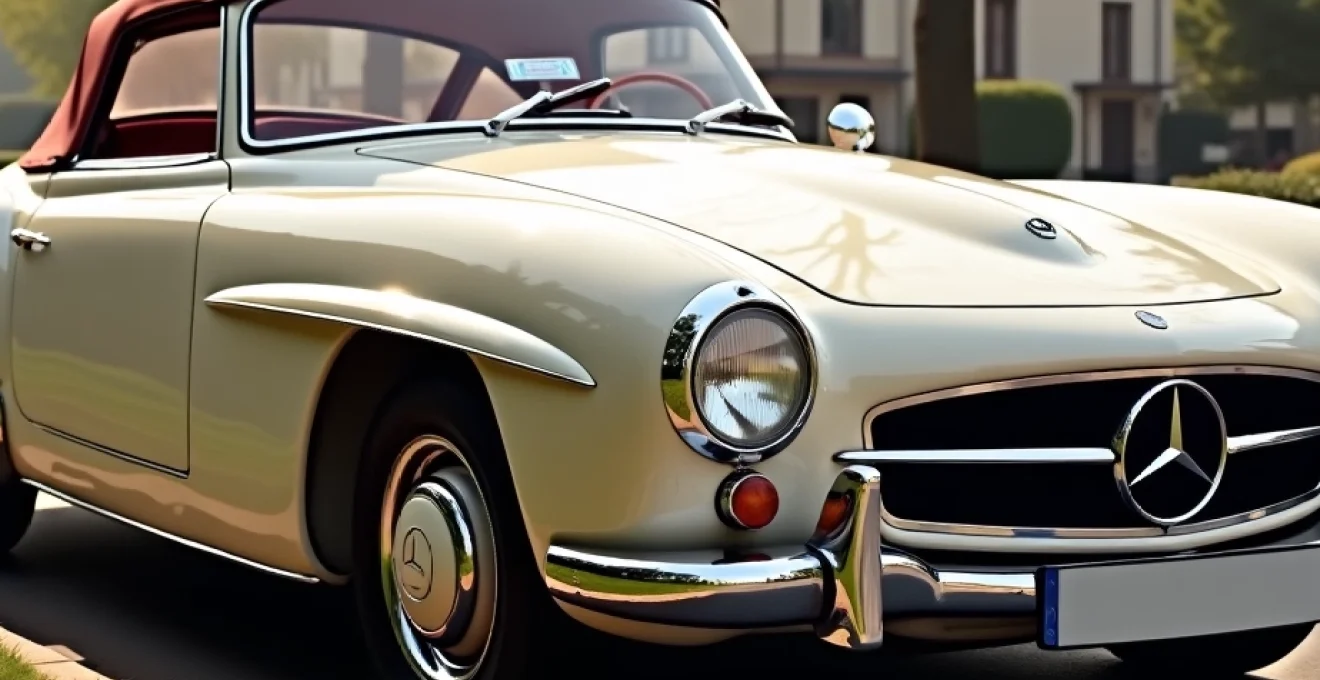
The Mercedes-Benz 190 SL stands as one of the most elegant and approachable classics from the Stuttgart marque’s golden era. Conceived through the persuasive efforts of American importer Max Hoffman, this roadster emerged as a more accessible alternative to the legendary 300 SL Gullwing, yet retained the sophisticated engineering and timeless styling that defined Mercedes-Benz in the 1950s. With only 25,881 examples produced between 1955 and 1963, the 190 SL has evolved from an affordable entry point into classic car ownership to a highly sought-after collector’s piece commanding substantial sums at auction.
What makes the 190 SL particularly compelling for today’s enthusiasts is its unique position in automotive history. It represents the birth of Mercedes-Benz’s long lineage of luxury roadsters, establishing design and engineering principles that would influence the marque’s convertibles for decades to come. The combination of elegant proportions, robust mechanical simplicity, and genuine Mercedes-Benz craftsmanship creates an ownership proposition that balances driving pleasure with investment potential.
Mercedes-benz 190 SL production history and model variants analysis
The 190 SL’s development story began with Max Hoffman’s recognition of American market demand for an elegant European roadster that offered Mercedes-Benz prestige without the extreme performance focus of the 300 SL. When both models debuted at the 1954 New York Auto Show, the 190 SL immediately captured attention with its flowing lines that cleverly adapted the 300 SL’s dramatic styling to a more conventional platform.
W121 chassis development timeline 1955-1963
Mercedes-Benz assigned the W121 chassis designation to the 190 SL, distinguishing it from the W198 300 SL’s space-frame construction. The W121 utilised a modified version of the contemporary saloon car platform, providing greater structural simplicity and repair accessibility compared to its exotic sibling. Production commenced in May 1955 at the Sindelfingen facility, with the majority of early examples destined for the lucrative American market.
Throughout its eight-year production run, the 190 SL received relatively few modifications, reflecting Mercedes-Benz’s confidence in the original design. The most significant changes occurred in 1956 when the engine mounting system was upgraded from three-point to four-point configuration, improving refinement and reducing vibration. The same year saw the introduction of optional power-assisted brakes, which became standard equipment on later models. Visual updates were minimal, with revised taillights in 1956 and subtle modifications to interior appointments in subsequent years.
Engine specifications: M121 1.9-litre Four-Cylinder unit
The heart of every 190 SL was the M121 engine, a sophisticated 1,897cc four-cylinder unit that showcased Mercedes-Benz’s advanced metallurgy and engineering prowess. This all-new powerplant featured a cast-iron block topped with an aluminium cylinder head, utilising a single overhead camshaft to actuate the valves. The engine’s design philosophy emphasised reliability and refinement over outright performance, producing 105 horsepower at 5,700 rpm and 145 Nm of torque at 3,200 rpm.
What distinguished the M121 from contemporary rivals was its sophisticated fuel delivery system. Twin Solex PHH44 carburettors provided precise fuel metering, though these units proved notoriously sensitive to adjustment and maintenance. Many owners eventually converted to Weber carburettors for improved reliability and easier servicing. The engine’s robust construction ensured longevity when properly maintained, with many examples still running on original internal components after six decades of service.
Roadster vs hardtop configuration options
Mercedes-Benz offered customers a choice between soft-top convertible and removable hardtop configurations, though the distinction wasn’t as straightforward as it might initially appear. The standard 190 SL featured a fabric soft top with a substantial folding framework, providing genuine open-air motoring when conditions permitted. However, many customers also specified the optional steel hardtop, which transformed the car’s character entirely.
The hardtop option presented both advantages and complications for ownership. While it provided superior weather protection and a more coupé-like driving experience, early hardtops lacked rear quarter windows, creating significant blind spots. More importantly, cars equipped solely with hardtops offered no fallback option when caught in unexpected weather, as they lacked the separate soft-top mechanism entirely. This limitation occasionally stranded owners who had left their hardtops at home, highlighting the importance of verifying which configuration accompanies any potential purchase.
Factory colour codes and original paint schemes
Mercedes-Benz offered an extensive palette of colours for the 190 SL, reflecting the model’s positioning as a lifestyle vehicle rather than a pure sports car. Popular choices included classic shades such as Signal Red, Papyrus White, and various metallic greys that showcased the car’s elegant proportions. The factory also provided several blue options, ranging from subtle Midnight Blue to more vibrant Azure Blue, each paired with carefully coordinated interior trim.
Original paint codes remain crucial for authenticity verification , as they appear on both the factory data card and various body panels. Collectors particularly prize cars retaining their original colour schemes, especially when accompanied by matching interior appointments. Some colour combinations, such as Silver Metallic with blue leather interior, have achieved legendary status among enthusiasts and command premium prices at auction.
Technical inspection criteria for 190 SL acquisitions
Acquiring a Mercedes-Benz 190 SL requires meticulous attention to both visible and hidden technical aspects. Unlike modern vehicles where computerised diagnostics reveal mechanical condition, these classics demand traditional inspection methods combined with deep knowledge of model-specific vulnerabilities. The 190 SL’s construction methods and materials create particular challenges that potential buyers must understand before committing to a purchase.
Swing axle rear suspension assessment procedures
The 190 SL’s independent rear suspension represents both an engineering achievement and a potential source of expensive repairs. This sophisticated system, shared with the 300 SL, utilises swing axles that provide excellent ride quality but require precise maintenance to prevent premature wear. During inspection, listen carefully for differential noise during acceleration and deceleration, particularly the characteristic “clunking” sounds that indicate worn half-shaft or pinion seals.
Rear suspension mounting points deserve particular scrutiny, as corrosion in these areas compromises both safety and structural integrity. The mounting brackets for the rear springs are notorious for spectacular corrosion failures if left unattended. Inspect these areas thoroughly , preferably with the car elevated to examine the underside completely. Any signs of previous welding or repair work should prompt professional evaluation, as improper repairs can create ongoing problems.
Solex carburettor system evaluation methods
The twin Solex PHH44 carburettors represent perhaps the most contentious aspect of 190 SL ownership. These sophisticated units were originally chosen as a last-resort solution when Mercedes-Benz’s preferred supplier failed to deliver, resulting in carburettors that were developed hastily and have proven problematic throughout the model’s history. Symptoms of carburettor problems include irregular idling, flat spots during acceleration (particularly between 1,500-1,900 rpm), and general poor running characteristics.
When evaluating a 190 SL’s carburettor system, observe the engine’s behaviour across its entire operating range. Pay particular attention to cold starting procedures , idle stability, and throttle response. Many specialists recommend converting to Weber carburettors for improved reliability, though this modification affects originality scoring for concours events. The conversion typically costs less than rebuilding the original Solex units while providing superior performance and easier maintenance.
Body panel rust identification in sill sections
Corrosion represents the greatest threat to any 190 SL’s long-term viability, with the model’s double-wall construction creating numerous areas where moisture can accumulate undetected. The sill sections, running along each side of the car beneath the doors, are particularly vulnerable due to their position and the tendency for drainage holes to become blocked over time. These structural elements are crucial for the car’s rigidity and safety, making their condition paramount for any potential purchase.
Professional inspection should include removal of interior trim panels to examine sill sections from inside the cabin. Surface rust may appear minimal while hiding extensive structural damage beneath. The stone guard areas at the rear of each sill typically show the first signs of serious corrosion, often spreading forward along the entire length if left untreated. Budget for complete sill replacement if any section shows signs of structural weakness, as partial repairs rarely provide lasting solutions.
Mechanical fuel pump and cooling system diagnostics
The 190 SL’s mechanical fuel pump and cooling system represent critical components that can cause significant problems if neglected. The mechanical fuel pump, mounted on the engine block, is susceptible to diaphragm failure, particularly when exposed to modern ethanol-blended fuels. Symptoms include fuel starvation under acceleration, irregular idle characteristics, and visible fuel leaks around the pump housing.
Cooling system evaluation requires checking the water pump for leaks, examining all hoses for deterioration, and verifying proper thermostat operation. Water pump failure can lead to catastrophic engine damage if overheating occurs, making this component’s condition crucial for any purchase decision. The radiator should be pressure-tested to ensure integrity, and the cooling fan operation should be verified across all operating temperatures.
Market valuation factors and price analysis framework
The 190 SL market has experienced dramatic transformation over the past two decades, evolving from an affordable entry point into Mercedes-Benz classic ownership to a premium collector car segment. Current market values reflect this evolution, with concours-quality examples commanding prices that would have seemed unimaginable just ten years ago. Understanding the factors that drive these valuations is essential for anyone considering a 190 SL acquisition.
Condition remains the primary value determinant , with the gap between excellent and poor examples widening significantly in recent years. Project cars requiring comprehensive restoration now trade for £30,000-45,000, while good driving examples typically command £60,000-80,000. Concours-standard restorations easily exceed £100,000, with exceptional examples approaching £170,000 at auction. The most expensive recorded sale reached £220,000 for a fully restored, matching-numbers example with impeccable provenance.
Values vary wildly as rusty cars and incomplete projects with missing trim will require a hefty sum to get right. Seeing as that bodywork can hide all manner of expensive issues, be sure to get a specialist to thoroughly examine your potential purchase.
Geographic factors also influence pricing significantly. European examples often command premiums over their American counterparts due to different storage conditions and maintenance cultures. However, cars with comprehensive restoration documentation and matching numbers verification can overcome geographic prejudices. The presence of original accessories, particularly the removable hardtop, can add substantial value to any transaction.
Market timing considerations suggest that values may have reached a plateau after years of steady increases. However, the limited production numbers and growing appreciation for 1950s design suggests long-term stability for well-chosen examples. Buyers should focus on acquiring the best available example within their budget rather than hoping to improve value through restoration work, as the costs involved typically exceed the resulting appreciation.
Authentication process for original 190 SL components
Verifying the authenticity and originality of a Mercedes-Benz 190 SL requires systematic examination of numerous identifying marks and characteristics. The hand-built nature of these vehicles, combined with their production methods, creates unique opportunities for authentication that don’t exist with modern mass-produced cars. Each component tells part of the car’s story, making thorough documentation essential for establishing provenance and value.
Matching numbers verification for engine and transmission
Mercedes-Benz stamped identifying numbers on multiple components throughout each 190 SL, creating a comprehensive system for verifying originality. The engine block bears the chassis number on the front left side, just below the cylinder head gasket area, allowing verification that the engine belongs to the specific vehicle. Similarly, the transmission, steering box, and both front and rear axles carry corresponding markings that should match the car’s documentation.
The process extends beyond major mechanical components to include wheels, which were stamped with production dates that should correspond to the vehicle’s manufacturing period. Body panels also received individual numbering , with doors, bonnet, and boot lid all bearing stamps that verify their authenticity to the specific chassis. This comprehensive marking system makes it possible to determine whether a car retains its original components or has been assembled from various sources.
Factory data card interpretation and documentation
Mercedes-Benz factory data cards represent the ultimate authority for determining a 190 SL’s original specification. These documents, available through Mercedes-Benz Classic, detail every aspect of the car’s factory configuration, including paint colour, interior trim, optional equipment, and delivery destination. The information contained within these cards enables owners to verify authenticity and guides restoration efforts toward original specifications.
Data card interpretation requires understanding Mercedes-Benz’s coding systems from the 1950s and 1960s. Paint codes, interior trim options, and accessory listings all follow specific formats that reveal the car’s factory configuration. Discrepancies between the data card and physical evidence may indicate modifications, accident damage, or component substitution during the vehicle’s history. Professional verification services can assist with data card acquisition and interpretation for significant purchases.
Period-correct accessories and optional equipment lists
The 190 SL’s optional equipment list included numerous accessories that enhance both authenticity and value in today’s market. The most significant option was the removable steel hardtop, which commanded a substantial premium when new and adds considerable value to surviving examples. Other period accessories included specific wheel designs, radio equipment, and various interior appointments that reflected the car’s luxury positioning.
Verifying period-correct accessories requires detailed knowledge of Mercedes-Benz’s accessory catalogues from the production years. Some items, such as the distinctive luggage set designed specifically for the 190 SL’s boot compartment, are extremely rare and valuable. Tool kits, spare wheel covers, and even owner’s manuals contribute to a car’s completeness scoring at concours events and influence market values accordingly.
Restoration considerations and parts availability assessment
Contemplating a Mercedes-Benz 190 SL restoration requires realistic assessment of both financial commitments and parts availability. Unlike some classic cars where restoration costs can be predicted with reasonable accuracy, the 190 SL’s hand-built construction methods create unique challenges that can multiply projected budgets. The good news is that parts availability remains relatively strong, thanks to both Mercedes-Benz Classic and numerous specialist suppliers worldwide.
Labour costs represent the most significant variable in any restoration project. The 190 SL’s construction methods, which involved fitting each panel individually to specific tolerances, means that restoration work requires exceptional skill and patience. Body work alone can consume 200-300 hours for a comprehensive restoration, with hourly rates at specialist facilities often exceeding £80-100. Mechanical restoration typically requires fewer hours but demands specific knowledge of the model’s unique characteristics.
Parts pricing varies dramatically between different categories of components. Mechanical items such as engine internals, transmission components, and suspension elements remain reasonably affordable through both Mercedes-Benz Classic and aftermarket suppliers. However, trim pieces, chrome work, and interior components can command shocking prices. A complete interior re-trim can cost £8,000-12,000, while chrome re-plating for a full car may exceed £15,000 at specialist facilities.
The decision between original and reproduction parts affects both cost and authenticity. Mercedes-Benz Classic maintains production capabilities for many critical components, ensuring perfect fit and finish but at premium prices. Reproduction alternatives offer cost savings but may compromise authenticity for concours competition. Many successful restorations combine genuine Mercedes parts for visible components with quality reproductions for hidden elements , balancing cost control with authenticity requirements.
Due to the age and complexity of restoring these vehicles, we strongly advise you acquire a 190 SL from a specialist who has checked for all of these issues outlined. Similarly, purchasing a Mercedes 190 SL from a specialist ensures you are purchasing a car that has had work carried out prior to going on sale.
Investment potential and classic car market positioning
The Mercedes-Benz 190 SL occupies a unique position within the classic car investment landscape, offering characteristics that appeal to both driving enthusiasts and financial investors. Its combination of accessible performance, elegant styling, and Mercedes-Benz prov
enance creates a compelling investment proposition for discerning collectors. The model’s production history, limited to just 25,881 examples over eight years, ensures long-term scarcity that typically supports value appreciation in the classic car market.
Historical price performance demonstrates the 190 SL’s evolution from affordable classic to premium collectible. In the early 2000s, decent examples could be acquired for £25,000-35,000, while today’s market sees similar cars commanding £60,000-80,000. This appreciation rate has consistently outperformed traditional investment vehicles, though past performance cannot guarantee future returns. The key to successful 190 SL investment lies in acquiring the finest available example, as condition gaps continue widening between excellent and mediocre cars.
Market dynamics favour the 190 SL’s long-term prospects for several compelling reasons. The model represents the genesis of Mercedes-Benz’s roadster tradition, establishing design themes that influenced every subsequent convertible from the marque. This historical significance, combined with the car’s elegant proportions and sophisticated engineering, creates enduring appeal that transcends temporary market fluctuations. Additionally, the 190 SL’s mechanical accessibility makes it more practical for regular use compared to more exotic contemporaries, supporting owner satisfaction and market stability.
Current market positioning places the 190 SL in direct competition with other premium European classics from the same era. Compared to Porsche 356 Speedsters or Ferrari 250 GT Spiders, the Mercedes offers superior build quality and parts availability at more accessible price points. However, potential investors must recognise that restoration costs can easily exceed purchase prices for project cars, making condition assessment absolutely critical. The most successful 190 SL investments typically involve acquiring restored examples from reputable specialists, avoiding the risks and uncertainties associated with restoration projects.
Geographic considerations influence both acquisition opportunities and long-term value prospects. European examples often demonstrate superior preservation due to climate conditions and maintenance cultures, while American cars may offer value opportunities despite potential shipping costs. The growing international appreciation for 1950s design, particularly among younger collectors entering the market, suggests sustained demand for well-preserved examples. However, the increasing sophistication of reproduction parts raises authenticity concerns that may affect future valuations, emphasising the importance of comprehensive documentation and provenance verification.
The 190 SL market has experienced dramatic transformation over the past two decades, evolving from an affordable entry point into Mercedes-Benz classic ownership to a premium collector car segment where concours-standard restorations easily exceed £100,000, with exceptional examples approaching £170,000 at auction.
Risk factors for 190 SL investment include the model’s dependence on specialist knowledge for proper maintenance and restoration. Unlike more common classics with widespread mechanical familiarity, the 190 SL requires specific expertise that may become increasingly scarce as knowledgeable technicians retire. Additionally, the car’s sophisticated carburettor system and swing-axle suspension create potential reliability issues that could deter casual collectors. These factors suggest that 190 SL values may become increasingly polarised, with exceptional examples continuing to appreciate while problematic cars face declining interest.
The investment outlook for Mercedes-Benz 190 SL models appears cautiously optimistic for buyers who approach the market with realistic expectations and sufficient capital reserves. The combination of historical significance, limited production numbers, and enduring aesthetic appeal provides a solid foundation for long-term value retention. However, successful 190 SL ownership requires commitment to proper maintenance and realistic assessment of total ownership costs. Buyers who acquire well-documented, properly restored examples from reputable sources are most likely to enjoy both the driving experience and potential financial returns that make the 190 SL such a compelling classic car choice.