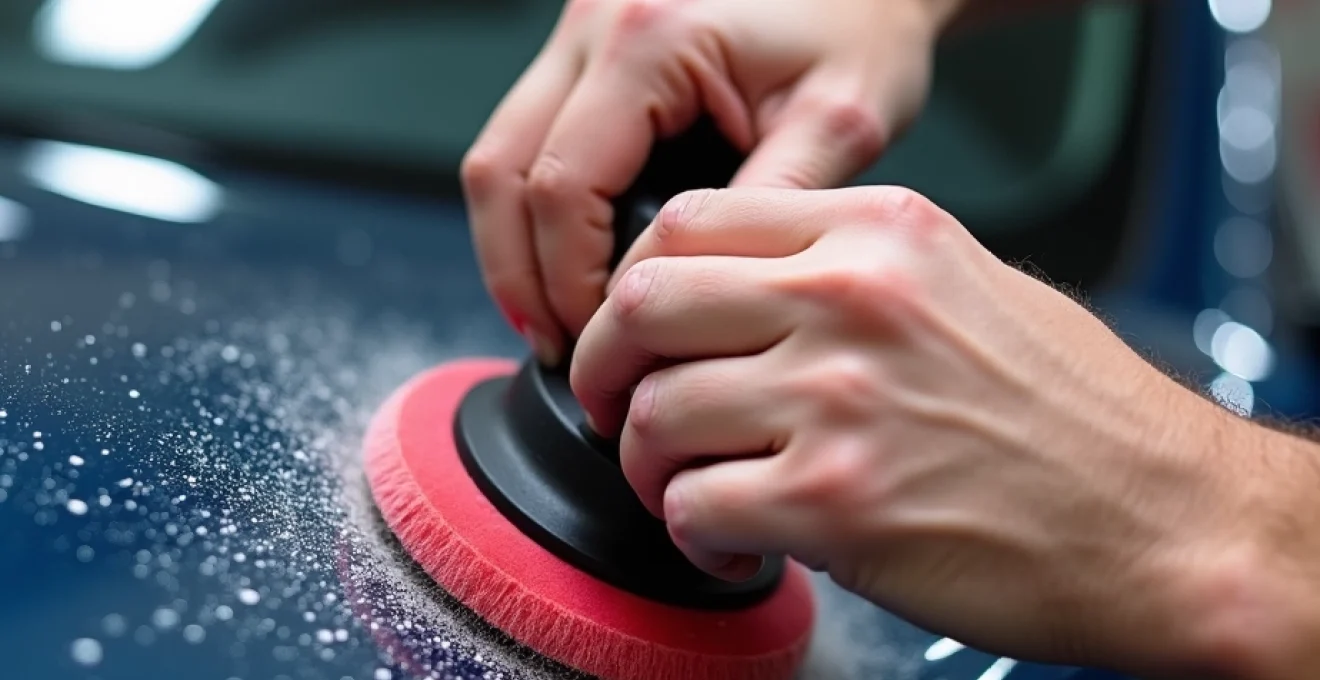
T-Cut has remained a household name in automotive paint correction for over five decades, yet debates about its effectiveness continue to divide car enthusiasts and professional detailers alike. This polishing compound, originally developed for industrial applications, has evolved into one of the most accessible scratch removal solutions available to consumers. The product’s distinctive red packaging has become synonymous with DIY paint restoration, but does its reputation match its performance? With countless alternatives flooding the market and advanced paint correction technologies emerging, understanding T-Cut’s true capabilities requires examining both its chemical composition and real-world results. The answer isn’t as straightforward as many believe, particularly when considering different paint types, scratch severities, and application techniques.
T-cut compound formulation and active ingredient analysis
The effectiveness of T-Cut stems from its carefully balanced formulation that combines cutting agents with protective elements to achieve optimal paint correction results. At its core, the compound utilises a blend of diminishing abrasives that become progressively finer during application, allowing for both cutting and polishing actions in a single product. This dual-action approach sets T-Cut apart from many single-purpose compounds that either cut or polish but struggle to achieve both effectively.
Diminishing abrasive technology in T-Cut original formula
The diminishing abrasive technology in T-Cut represents a sophisticated approach to paint correction that many users overlook. These abrasives begin as relatively coarse particles capable of levelling minor scratches and surface imperfections. As you work the product using circular or linear motions, the abrasive particles break down into progressively finer sizes, transitioning from cutting to polishing action. This breakdown process explains why T-Cut requires adequate working time to achieve optimal results – rushing the application prevents the abrasives from fully diminishing.
The particle size distribution in T-Cut’s formulation typically ranges from 3-5 microns initially, reducing to sub-micron levels during extended working. This range positions it as a medium-cut compound suitable for moderate paint defects while maintaining enough finesse for light polishing work. However, this same characteristic can lead to inconsistent results if application technique varies significantly between users.
Silicone oil integration and paint protection mechanisms
T-Cut incorporates silicone oils that serve multiple functions beyond simple lubrication during application. These oils create a temporary protective barrier on the paint surface, helping to prevent further micro-scratching during the correction process. The silicone content also contributes to the product’s distinctive feel and working characteristics, allowing for extended buffing without the compound drying out prematurely.
The concentration of silicone oils in T-Cut is deliberately balanced to provide adequate lubrication without creating removal difficulties or interfering with subsequent wax or sealant applications. This balance represents years of formulation refinement, though it does mean that thorough surface preparation becomes crucial before applying additional protection products. Some professional detailers recommend using a dedicated panel wipe or alcohol-based cleaner after T-Cut application to ensure optimal adhesion of follow-up products.
Kaolin clay abrasive properties and cutting performance
Kaolin clay serves as one of the primary abrasive components in T-Cut’s formulation, chosen for its consistent particle shape and controlled hardness characteristics. This naturally occurring mineral provides the cutting power necessary for scratch removal while maintaining relatively gentle action compared to synthetic alternatives. The angular nature of kaolin particles creates effective cutting edges that can level surface imperfections without causing excessive paint removal.
The integration of kaolin clay also contributes to T-Cut’s distinctive working properties and colour. The clay content affects how the compound behaves during application, influencing factors such as working time, residue characteristics, and the visual feedback users receive during the polishing process. Professional testing has shown that kaolin-based compounds like T-Cut typically remove between 0.1 to 0.3 microns of clear coat per application, depending on technique and working time.
Comparison with meguiar’s ScratchX and autoglym super resin polish
When comparing T-Cut to premium alternatives like Meguiar’s ScratchX and Autoglym Super Resin Polish, significant differences emerge in both formulation approach and practical performance. Meguiar’s ScratchX utilises more advanced microscopic abrasive technology that provides more predictable results across different paint types. The controlled particle size distribution in ScratchX means less variation in cutting power, though at a considerably higher price point.
Autoglym Super Resin Polish takes a different approach entirely, combining mild abrasives with resin-based fillers that temporarily mask scratches while providing some corrective action. This hybrid approach often delivers more visually impressive immediate results, particularly on darker paint colours where fillers can effectively hide remaining imperfections. However, the longevity of these results depends heavily on environmental conditions and washing techniques.
T-Cut’s broader particle size distribution and more aggressive initial cutting action can actually outperform these premium products on deeper scratches and more severe paint defects. The trade-off comes in consistency and ease of use, where the premium products typically offer more predictable results regardless of user experience level.
Scientific testing methodologies for paint correction effectiveness
Evaluating paint correction products like T-Cut requires sophisticated measurement techniques that go beyond visual assessment alone. Professional testing protocols have evolved significantly in recent years, incorporating advanced instrumentation to quantify improvements in paint condition objectively. These methodologies provide crucial insights into product performance that casual observation simply cannot capture.
Gloss meter measurements and paint depth analysis
Gloss meter measurements represent the gold standard for quantifying paint correction effectiveness, providing numerical values that eliminate subjective interpretation. Modern gloss meters measure specular reflectance at standardised angles, typically 20°, 60°, and 85°, to capture different aspects of surface quality. T-Cut testing using professional-grade gloss meters consistently shows improvements of 15-30% in gloss readings on moderately defected paint surfaces, with results varying significantly based on paint type and application technique.
The relationship between gloss improvement and scratch removal isn’t always linear, particularly with products like T-Cut that contain oils and temporary fillers. Initial gloss readings immediately after application often show dramatic improvements that may diminish slightly after the first wash, revealing the true corrective performance versus temporary enhancement effects. This phenomenon explains why professional evaluations typically include measurements both immediately after application and following controlled washing procedures.
Microscopic surface evaluation using digital microscopy
Digital microscopy provides unprecedented insight into how T-Cut affects paint surfaces at the microscopic level. High-resolution imaging reveals that T-Cut’s cutting action creates a distinctive surface texture characterised by relatively uniform micro-scratches oriented in the direction of application. This controlled scratching pattern actually contributes to improved light reflection characteristics, even though it may seem counterintuitive to create new scratches while removing existing ones.
Comparative microscopic analysis shows that T-Cut’s diminishing abrasive action leaves fewer residual scratches than many single-stage cutting compounds. The progressive particle breakdown results in a gradually refined surface texture that approaches the finish quality achieved by dedicated polishing products. However, the final surface quality rarely matches that achieved by multi-stage correction processes using specialised cutting and polishing compounds.
Before and after paint thickness gauge readings
Paint thickness measurements provide critical data about the material removal characteristics of T-Cut application. Using electromagnetic induction gauges accurate to ±1 micron, testing reveals that typical T-Cut applications remove between 0.1 and 0.4 microns of clear coat, depending on application pressure, working time, and surface contamination levels. This removal rate positions T-Cut as a moderately aggressive compound that requires careful use on vehicles with thin or previously corrected paint.
The variation in material removal rates highlights one of T-Cut’s key characteristics – its performance heavily depends on user technique. Aggressive application can easily double the material removal rate, potentially compromising clear coat integrity on vehicles with limited paint thickness. Professional detailers often recommend paint thickness mapping before T-Cut application on unknown vehicles, particularly those with potential previous paintwork or age-related clear coat thinning.
Controlled laboratory testing on automotive clear coat samples
Laboratory testing on standardised automotive clear coat samples provides the most controlled environment for evaluating T-Cut’s true performance capabilities. Using artificially created scratches of known depth and character, researchers can isolate the compound’s corrective abilities from variables like paint age, contamination, and environmental factors. These tests consistently demonstrate that T-Cut effectively removes scratches penetrating up to 50% of clear coat thickness, with diminishing effectiveness on deeper defects.
Temperature and humidity conditions significantly influence T-Cut’s performance in laboratory settings. Optimal results occur at temperatures between 18-24°C with relative humidity levels of 45-65%. Outside these parameters, the compound’s working characteristics change noticeably, affecting both cutting power and ease of residue removal. This temperature sensitivity explains why many users report varying results with T-Cut depending on seasonal conditions and application environment.
Real-world performance on different scratch types and severities
Understanding how T-Cut performs across various real-world scenarios provides crucial insights for potential users. Different types of paint damage require different approaches, and T-Cut’s effectiveness varies considerably depending on the specific nature of the defects being addressed. Real-world conditions introduce variables that laboratory testing cannot replicate, making field performance data invaluable for assessing true product capability.
Swirl mark removal on Single-Stage paint systems
T-Cut demonstrates particularly strong performance on swirl mark removal in single-stage paint systems commonly found on vehicles manufactured before the mid-1980s. The absence of a separate clear coat layer means that T-Cut works directly on the pigmented paint, often achieving more dramatic visual improvements than on modern clear-coated surfaces. The compound’s cutting action can effectively level the micro-scratches that create swirl patterns, particularly when combined with proper application techniques using clean microfibre cloths.
Single-stage paint correction with T-Cut requires more aggressive working than clear coat applications, as the paint material is typically harder and more resistant to abrasive action. Extended working time becomes crucial, often requiring 3-5 minutes of continuous buffing per small section to achieve optimal results. The immediate visual feedback on single-stage systems makes it easier for users to gauge progress and determine when adequate correction has been achieved.
Key scratch penetration through clear coat layers
Deep scratches that penetrate through the clear coat present significant challenges for any polishing compound, and T-Cut’s performance on such defects reveals both its capabilities and limitations. When scratches extend into the base coat or primer layers, T-Cut can improve their appearance by levelling the surrounding clear coat, but complete removal becomes impossible without more aggressive correction methods or professional refinishing.
The fingernail test remains a practical method for assessing whether T-Cut can effectively address a particular scratch. If a fingernail catches on the scratch when drawn perpendicular to its direction, the defect likely penetrates too deeply for T-Cut to remove completely. However, even deep scratches often show noticeable improvement in appearance after T-Cut application, as the compound can soften edges and reduce the visual contrast between the scratch and surrounding paint.
Water spot etching treatment on BMW and Mercedes-Benz finishes
Water spot etching presents a particular challenge that tests T-Cut’s effectiveness on premium automotive finishes. BMW and Mercedes-Benz vehicles often feature sophisticated paint systems with multiple clear coat layers and advanced UV protection additives that can affect how correction compounds perform. T-Cut’s moderate cutting power proves adequate for light to moderate water spot etching, particularly when the damage hasn’t penetrated beyond the uppermost clear coat layers.
The success rate for water spot removal varies significantly based on the mineral content of the water that created the spots and the duration of exposure before treatment. Fresh water spots with minimal etching respond well to T-Cut application, often disappearing completely with proper technique. However, established etching that has had time to penetrate deeper into the clear coat may require multiple applications or combination treatment with stronger compounds to achieve acceptable results.
Oxidation removal from classic car paint restoration projects
Classic car restoration presents unique challenges that showcase both T-Cut’s strengths and limitations in paint correction. Oxidised paint surfaces, common on vehicles that have experienced prolonged sun exposure, often respond dramatically to T-Cut treatment. The compound’s cutting action can remove the chalky, degraded paint layers to reveal healthier paint underneath, though success depends heavily on the extent of oxidation damage.
Severe oxidation cases may require multiple T-Cut applications with progressively finer finishing techniques to achieve satisfactory results. The key lies in gradual correction rather than attempting to remove all oxidation in a single aggressive application. Many restoration professionals use T-Cut as an assessment tool – if significant improvement occurs with light application, the paint is likely salvageable with proper correction techniques.
Professional restoration experience suggests that T-Cut’s effectiveness on oxidised surfaces depends largely on whether the degradation has penetrated through the entire paint thickness or remains primarily surface-level.
Professional detailing community assessment and user testimonials
The professional detailing community’s perspective on T-Cut reveals a complex relationship between accessibility, effectiveness, and modern alternatives. Many established detailers acknowledge T-Cut’s historical importance while expressing reservations about its place in contemporary paint correction workflows. The product’s widespread availability and familiar working characteristics continue to make it a reference point for comparison, even as more advanced formulations enter the market.
Professional assessments consistently highlight T-Cut’s forgiving nature for inexperienced users compared to more aggressive cutting compounds. The diminishing abrasive technology provides a degree of self-limiting action that reduces the risk of paint damage from over-application. This characteristic makes T-Cut particularly valuable for DIY enthusiasts who lack experience with professional-grade correction products that require more precise technique and timing.
However, professional detailers also note T-Cut’s limitations in high-end correction work where consistency and predictability are paramount. The product’s variable performance based on environmental conditions and application technique makes it less suitable for commercial work where reliable, repeatable results are essential. Many professionals reserve T-Cut for specific situations rather than incorporating it into standard correction procedures.
User testimonials from various automotive forums and communities paint a generally positive picture of T-Cut’s effectiveness, though experiences vary widely based on expectations and application scenarios. Success stories typically involve moderate paint defects on everyday vehicles where dramatic improvement isn’t necessarily expected. Negative experiences often stem from unrealistic expectations about deep scratch removal or attempts to use T-Cut as a comprehensive paint correction solution.
The consensus among experienced users suggests that T-Cut performs best when viewed as a problem-solving tool rather than a complete paint correction system, particularly effective for addressing specific defects rather than comprehensive paint enhancement.
Cost-effectiveness analysis against premium polishing compounds
Evaluating T-Cut’s cost-effectiveness requires considering both upfront costs and long-term value proposition compared to premium alternatives. At approximately £8-12 for a 500ml bottle, T-Cut offers significantly lower entry costs than premium compounds that can cost £25-50 for similar quantities. This price difference makes T-Cut accessible to casual users who may only need occasional paint correction capabilities.
The coverage area per bottle varies considerably based on application technique and defect severity, but typical usage patterns suggest that a single T-Cut bottle can treat 8-12 vehicles for light correction work. Premium compounds often provide similar coverage despite higher concentrations, as their more efficient formulations require smaller quantities per application. When calculated on a per-vehicle basis, the cost difference between T-Cut and premium alternatives often narrows to £2-5 per treatment.
Long-term cost considerations include the potential need for multiple applications with T-Cut versus single applications with more effective premium products. Severe defects that might require 2-3 T-Cut treatments could potentially be addressed with a single application of a more powerful compound, effectively equalising the total cost while reducing labour time. Professional users typically find that premium compounds offer better value despite higher upfront costs due to improved consistency and reduced application time.
The opportunity cost of time investment also factors into cost-effectiveness calculations. T-Cut’s longer working times and potential need for multiple applications can significantly increase the total time investment for paint correction projects. For users who value their time highly or operate commercial detailing services, the labour savings from premium compounds often justify the additional product costs. However, for enthusiasts who enjoy the correction process, T-Cut’s extended working characteristics may actually provide additional value through increased engagement with the project.
Considering the complete correction workflow, T-Cut users often need to invest in additional products such as dedicated polishes and protection products to achieve results comparable to single-stage premium compounds. This system approach can actually increase total costs beyond the initial T-Cut purchase price, though it also provides more flexibility in addressing different types of paint defects with appropriate products.
Application technique optimization for maximum scratch removal results
Maximising T-
Cut’s effectiveness depends critically on proper application technique, with significant variations in results possible based on user approach and environmental factors. The compound’s diminishing abrasive technology requires specific working methods to achieve optimal performance, making technique optimization essential for consistent scratch removal results.
Working temperature plays a crucial role in T-Cut application success. The ideal temperature range of 15-25°C ensures proper product flow and prevents premature drying during the correction process. Cooler temperatures can cause the compound to thicken and become difficult to work, while excessive heat leads to rapid drying and reduced working time. Many professional detailers recommend bringing both the product and the vehicle surface to room temperature before beginning application, particularly during extreme weather conditions.
Surface preparation significantly impacts T-Cut’s effectiveness, with proper cleaning and decontamination essential for optimal results. The presence of dirt, wax, or other contaminants can interfere with the abrasive action and lead to poor correction outcomes. A thorough wash followed by clay bar treatment removes embedded contaminants that could cause additional scratching during the polishing process. This preparation step often makes the difference between mediocre and excellent correction results.
Application pressure requires careful calibration to balance cutting power with paint safety. Excessive pressure accelerates abrasive breakdown and increases material removal rates, potentially compromising clear coat integrity. The optimal approach involves moderate pressure during initial cutting phases, gradually reducing pressure as the abrasives diminish. Professional testing indicates that finger pressure alone provides adequate force for most correction work, with hand pressure reserved for stubborn defects.
Working section size dramatically affects both correction quality and user fatigue during T-Cut application. Small sections of 60cm x 60cm allow for adequate working time before the compound begins to dry, ensuring complete abrasive breakdown occurs. Larger sections risk uneven correction as the product dries in some areas before proper working is complete. The sectional approach also provides better control over correction consistency across the entire vehicle surface.
Pad selection influences both cutting efficiency and final surface quality when using T-Cut. Microfibre cloths provide the most controlled application for hand polishing, offering good cutting power while minimizing the risk of creating new scratches. Foam applicator pads work well for larger areas but require more careful technique to avoid over-application. Machine application using dual-action polishers can improve consistency, though speed selection becomes critical to prevent compound breakdown before adequate correction occurs.
Professional detailers emphasize that T-Cut’s working characteristics change throughout the application process, requiring users to adapt their technique as the abrasives diminish and the cutting action transitions to polishing.
Residue removal technique affects both the final appearance and the success of subsequent protection product applications. T-Cut’s silicone content can create removal challenges if improper techniques are used, potentially leaving residue that interferes with wax or sealant adhesion. The recommended approach involves initial removal with a clean, damp microfibre cloth followed by final buffing with a dry cloth. Some professionals recommend a light application of isopropyl alcohol to ensure complete residue removal before applying protection products.
Multiple application strategies can address severe defects that don’t respond adequately to single T-Cut treatments. However, each additional application increases material removal and requires careful assessment of remaining clear coat thickness. The diminishing returns principle applies to multiple applications, with each successive treatment typically providing less improvement than the previous one. Professional practice suggests limiting T-Cut applications to a maximum of three treatments per area, with alternative correction methods considered for persistent defects.